Grain and Bear It: The Billionaire Analog Phase Is Flooding Estate Sales With Mint Vintage Cameras and Vinyl Nobody Played
Editor's note: Yes, this is in Food & Drink. We're stretching the category to include 'consumption of culture,' which is something wealthy people do voraciously and briefly before spitting it back out. We stand by this.
There is a particular flavor of wealthy person who, having conquered the digital world, decides that what they really need is to reconnect with something tactile, impermanent, and inconvenient. They want grain in their photographs. They want the warm crackle of a needle finding a groove. They want to develop film in a darkroom that cost $40,000 to build in their Marin County home and will be used approximately eleven times before being converted back into a wine cellar.
This person is not a villain. This person is, in fact, a benefactor — though they don't know it yet. Because in twelve to eighteen months, every piece of equipment they acquired in their analog awakening is going to enter the secondary market in near-pristine condition, and someone with patience and a modest budget is going to eat extraordinarily well.
The Anatomy of an Authenticity Phase
Let's trace the lifecycle, because it follows a pattern as reliable as the seasons:
Month 1-2: The Revelation. Our subject — let's call him a recently-exited founder, or a hedge fund manager who just turned 50, or a tech executive who read a long-form piece about the resurgence of film photography in The New Yorker — decides that digital everything has made life feel hollow. He is not wrong about this. The solution he reaches for, however, involves a credit card and approximately zero patience for developing actual skills.
Month 2-4: The Acquisition Phase. This is where it gets beautiful from a secondary-market perspective. Our subject doesn't buy one vintage camera. He buys six, because he's researched this extensively and needs to cover different formats. He acquires a Leica M6, a Hasselblad 500C/M, a Rolleiflex, and at least one large-format camera that requires a tripod the size of a small tree. He also buys every accessory: light meters, film changing bags, darkroom chemicals, an enlarger, archival paper. He spends, conservatively, $35,000 in a category he couldn't have named eight weeks ago.
The vinyl collection follows a parallel trajectory. He doesn't just buy a turntable. He buys a $4,000 Pro-Ject or a Rega Planar and then decides that's not quite right and upgrades to something with a tonearm that requires calibration by a specialist. He buys 400 records in three months, many of them original pressings of albums he's never actually listened to, because the cover art looked important and the seller on Discogs described them as "NM" (near mint).
Month 4-8: The Practice Phase (Such As It Is). He shoots some film. Some of it is genuinely good — beginner's luck is real, and good equipment helps. He posts the results. People are impressed. He attends a local photography meetup and discovers that the other participants are twenty-three years old and have been doing this for years and are considerably better than him, which is uncomfortable. He shoots less. The Hasselblad starts living on the shelf.
Month 8-18: The Pivot. Something else catches his attention. Maybe it's AI image generation. Maybe it's woodworking. Maybe it's the realization that developing film takes three hours and he has a company to run. The cameras migrate to increasingly inaccessible shelves. The records stop being played because the stylus needs replacing and he keeps forgetting to order one. The darkroom becomes a storage room.
Month 18-24: The Liquidation. And here we arrive at our moment of opportunity.
What's Actually Available Right Now
The current wave of analog enthusiasm among the wealthy kicked into high gear around 2020-2021, when a combination of pandemic introspection and general tech-industry soul-searching sent a significant cohort of high-net-worth individuals into camera shops and record stores with essentially unlimited budgets. Do the math on the eighteen-month lifecycle and you'll understand why the secondary market for vintage cameras and vinyl is currently extraordinary.
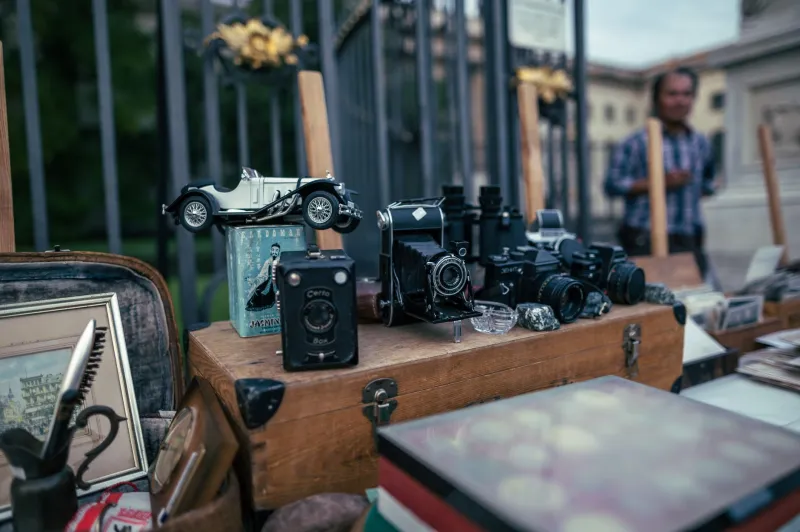
On the camera side: Leica M-series film cameras that were acquired for $4,000-$6,000 and used for one roll of film are appearing at estate sales, on Craigslist, and through camera dealers who've received estate consignments. Medium format equipment — Hasselblads, Mamiyas, Bronicas — is particularly abundant because it's expensive, intimidating, and requires more technical knowledge than most enthusiast-phase buyers develop. A Mamiya RZ67 that retailed for $1,800 in good condition is clearing estate sales for $600-$900 because nobody at the sale knows what it is.
On the vinyl side: First pressings and audiophile pressings acquired during the enthusiasm phase are surfacing everywhere. The issue is that wealthy buyers in acquisition mode often prioritize rarity over personal taste, which means the collections that emerge from these estates are sometimes extraordinary — original Blue Note jazz pressings, early Beatles UK pressings, audiophile 180-gram editions of classic albums — and sometimes completely incoherent, because the collector was buying on reputation rather than genuine musical interest.
Both categories are worth hunting in: estate sales in affluent neighborhoods, camera shops that accept consignments, record stores with estate buy programs, and the increasingly robust Facebook Marketplace listings in tech-heavy cities like San Francisco, Seattle, Austin, and Boston.
The People Buying the Collections
The people absorbing these abandoned analog lives are fascinating. In the camera world, there's a dedicated community of film photographers — many of them working professionals or serious amateurs — who've built entire acquisition strategies around the billionaire enthusiasm cycle. They monitor estate sales with the focus of day traders. They have relationships with camera repair technicians who can assess equipment remotely from a photo. They know which models are worth the gamble and which are expensive paperweights.
In the vinyl world, the buyers split into two camps: the genuine audiophiles who are after specific pressings for actual listening enjoyment, and the resellers who understand that a collection assembled by someone with money and no taste discrimination will occasionally contain items worth multiples of what the estate is asking.
Both groups share one quality: patience. This market rewards the people who show up consistently, build relationships with liquidators, and understand what they're looking at. The casual browser occasionally gets lucky. The dedicated hunter gets lucky regularly.
A Practical Note on Authentication and Condition
Vintage cameras require CLA — clean, lubricate, adjust — before serious use, regardless of how mint they appear. Budget $100-$200 per camera body for a technician to service it properly. A camera that looks perfect may have a shutter that fires incorrectly or light seals that have deteriorated. Shoot a test roll before committing to anything important.
Vinyl condition grades are subjective and often optimistic. "VG+" from an estate sale means something different than "VG+" from a specialist dealer. Bring a flashlight and examine the playing surface under direct light. A single deep scratch across a valuable pressing is the difference between a great find and an expensive coaster.
The Beautiful Irony, Briefly Acknowledged
There is something almost poetic about this entire cycle. A person spends forty years building technology that made analog media obsolete, then spends $35,000 trying to reclaim the analog experience, then abandons it within eighteen months and goes back to digital — leaving behind equipment that gets picked up by someone who genuinely loves it and will use it for decades.
The analog gear found its person. It just had to pass through a billionaire's identity crisis to get there.
The Hasselblad doesn't care about any of this. It just wants to make pictures. In that respect, it's considerably more grounded than anyone in this story.