Thrift Store Thunderdome: The Day Wealthy Americans Discovered 'Vintage' and Ruined Bargain Shopping for Everyone
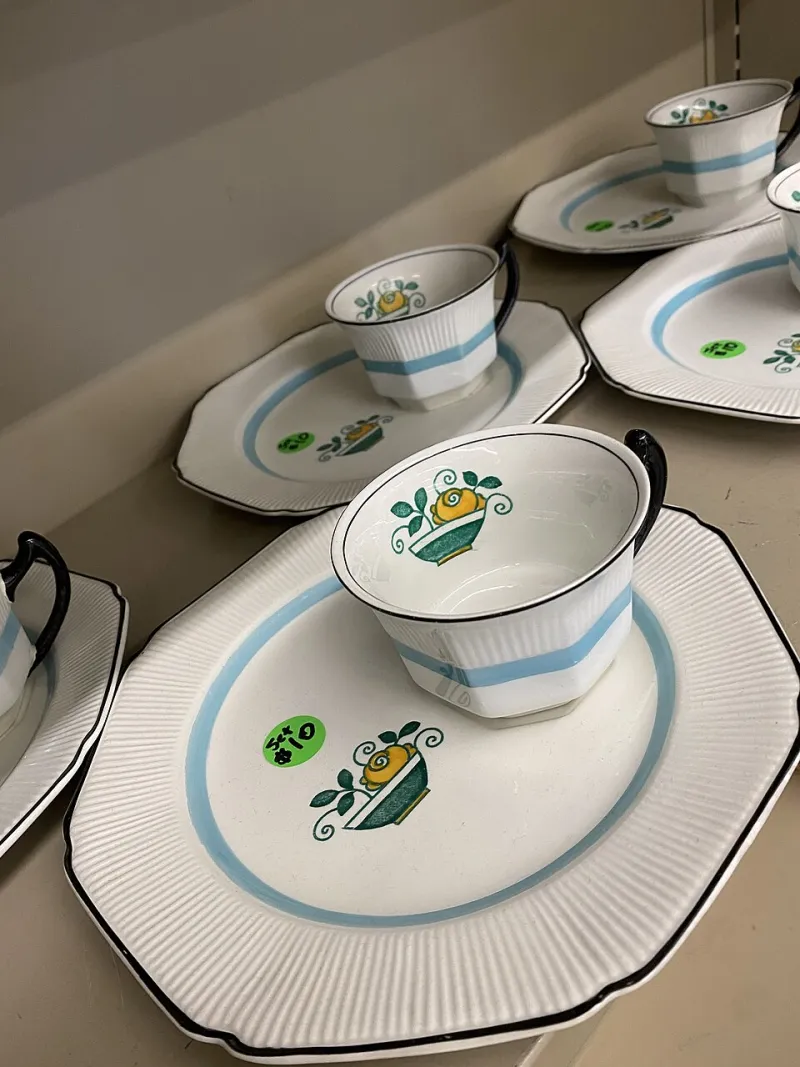
Photo: Anora McGaha (NCNorie), CC BY-SA 4.0, via Wikimedia Commons
Let me paint you a picture.
It's a Saturday morning at a Salvation Army in Pasadena, California. A woman in $280 Reformation jeans and a tote bag that says "Slow Down" is holding up a Pyrex casserole dish, photographing it from four different angles for her interiors Instagram. Next to her, a retired teacher on a fixed income is trying to find a set of plates that don't cost more than her monthly utilities. The Pyrex dish is tagged at $22.
This is not a story about the dish. This is a story about what the dish represents.
How We Got Here: A Brief, Painful History
Thrift stores were not always a contested terrain. For most of their existence — Goodwill was founded in 1902, which is an absolutely staggering thing to consider — they operated as a kind of democratic safety net disguised as a retail experience. You went in, you found things for cheap, you left feeling vaguely accomplished. Nobody was documenting the experience for content.
Then several things happened in rapid succession:
- Vintage fashion became aspirational rather than practical.
- Sustainability discourse made secondhand shopping a moral virtue rather than a financial necessity.
- TikTok and Instagram turned thrift hauls into a performance art form with millions of views.
- The word "thrifted" became a flex rather than a confession.
By 2019, "thrifting" had completed its full transformation from coping mechanism to lifestyle brand. By 2023, a Depop seller was charging $85 for a 1994 Hanes Beefy-T with a minor stain, and somehow this was acceptable to the market.
The Employees Have Seen Things
I spent time talking to thrift store workers across several states, most of whom requested either anonymity or that I describe them as "a source familiar with the situation" because, in their words, "the customers are unhinged and they know where I work."
A floor supervisor at a Goodwill in Austin, Texas — let's call her Marisol — described the transformation of her store's customer base with the weary precision of someone who has watched a neighborhood gentrify in real time.
"We used to have regulars who came in because they genuinely needed things," she told me. "Now on weekends, we have people who come in with a list of specific brands they're hunting. They'll spend two hours going through every rack, pull everything that looks remotely vintage, then leave with a cart full of stuff they're going to resell for ten times what they paid. Meanwhile, a family that actually needs winter coats shows up and there's nothing left in their size."
She paused. "One guy asked me if we had a 'back room' with better stuff. Like we were a speakeasy."
We were not, for the record, a speakeasy.
The Pricing Situation Is Getting Out of Hand
Here is where I must report some findings that will either vindicate your suspicions or ruin your weekend, depending on your current relationship with secondhand retail.
National thrift chains — Goodwill in particular — have implemented dynamic pricing systems in many locations that algorithmically adjust prices based on brand recognition and perceived resale value. This means the system knows that a J.Crew blazer is worth more than a no-name blazer, and it prices accordingly. The result is a thrift store that is, in certain product categories, no longer cheaper than TJ Maxx.
A partial field report from a single Saturday afternoon in three different metro-area Goodwills:
- Levi's 501 jeans (mid-90s, good condition): $24.99
- A KitchenAid stand mixer, no bowl, no attachments: $49.99
- A Patagonia fleece vest, minor pilling: $22.99
- A Vitamix blender, power cord frayed: $39.99
- A paperback copy of The Da Vinci Code: $1.99 (the one honest price in the building)
For context, a brand-new Levi's 501 currently retails for $69.50. You are being asked to pay $25 for someone else's jeans from the Clinton administration. This is the market now. This is what we've built.
A Satirical Field Guide to Performing Thriftiness (While Being Extremely Wealthy)
For those of you who have arrived at thrift stores from the direction of financial abundance and are unsure of the cultural protocols, I offer the following guide. This is satire. Mostly.
Step 1: Develop the vocabulary. You are not buying used clothes. You are "sourcing vintage." You are not buying a chipped ceramic bowl. You are "curating an imperfect aesthetic." You are not spending $40 at a thrift store. You are "investing in circular fashion."
Step 2: Dress the part. Wear something expensive enough that it reads as intentional irony. A $400 cashmere sweater over thrift store cords communicates that you chose this, which is the entire point.
Step 3: Post the haul. The thrift store visit is incomplete without documentation. The items matter less than the narrative of the items. A $3 linen blazer becomes a story about sustainability, personal style, and your grandmother's attic all at once.
Step 4: Express surprise at the prices. "Can you believe someone got rid of this?" is the required incantation. It positions you as a discoverer, an archaeologist of other people's discards, rather than a person who drove a $65,000 car to a charity shop.
The Actual Irony, Which I Will Now State Plainly
Here at Rich Garbage Man, we are philosophically committed to the idea that one person's discard is another person's treasure. We believe in the sacred economy of the overlooked object. We have, in fact, built an entire brand identity on the premise that the best stuff is often the stuff other people didn't want.
But there is a meaningful difference between finding value in what others discard and performing the finding of value in what others discard while simultaneously pricing out the people for whom those spaces were built.
The thrift store was never supposed to be a boutique. It was supposed to be the place you went when you needed a winter coat and couldn't afford a new one. The fact that it's now also the place wealthy people go to perform their sustainability values is not, in itself, a crime. But the downstream effects — higher prices, picked-over inventory, a cultural shift that reframes necessity as aesthetic — those are real, and they land on real people.
The flannel shirt costs $18 now. It used to cost $3. The difference is a TikTok video and a girl with good lighting.
The retired teacher got the Pyrex dish, by the way. The woman with the tote bag put it back after deciding the color "didn't feel right for the space."
Some days, the good guys win.