Namaste, Liquidation: How Boutique Gym Bankruptcies Became America's Greatest Fitness Equipment Fire Sale
There is a particular kind of poetry in watching a $150-per-month spin studio get reduced to a Craigslist posting that reads: "47 Peloton-adjacent bikes, slight cosmetic damage, buyer must bring own truck and emotional support." It is the poetry of capitalism eating itself, and frankly, it has never sounded so melodic — at least if you're the one showing up with a flatbed and a pocket full of twenties.
Welcome to the golden age of boutique fitness implosion. Pull up a foam roller. We need to talk.
The Rise, The Hype, and the Inevitable Faceplant
Somewhere between 2015 and the pandemic, America collectively decided that exercising in a regular gym — you know, with other humans and fluorescent lighting and that one guy who never wipes down the bench — was simply beneath them. Enter the boutique fitness era: curated, branded, Instagram-optimized sweat temples charging $35 a class with the confidence of a Michelin-starred restaurant and the long-term financial stability of a lemonade stand in a hurricane.
SoulCycle. Barry's Bootcamp. Rumble Boxing. OrangeTheory. Solidcore. The names alone sounded like tech startups naming themselves after abstract nouns and hoping for the best. And for a while — a glorious, overpriced while — it worked. Venture capital poured in. Celebrities endorsed. Influencers sweated picturesquely. The vibe was immaculate.
Then the pandemic happened, followed by inflation, followed by the collective American realization that $420 a month in spin classes was perhaps not a foundational financial strategy. The dominoes began to fall, and they fell loudly.
The Collapse Heard Round the Cycling Studio
Let's talk numbers, because the numbers are genuinely unhinged in the best possible way.
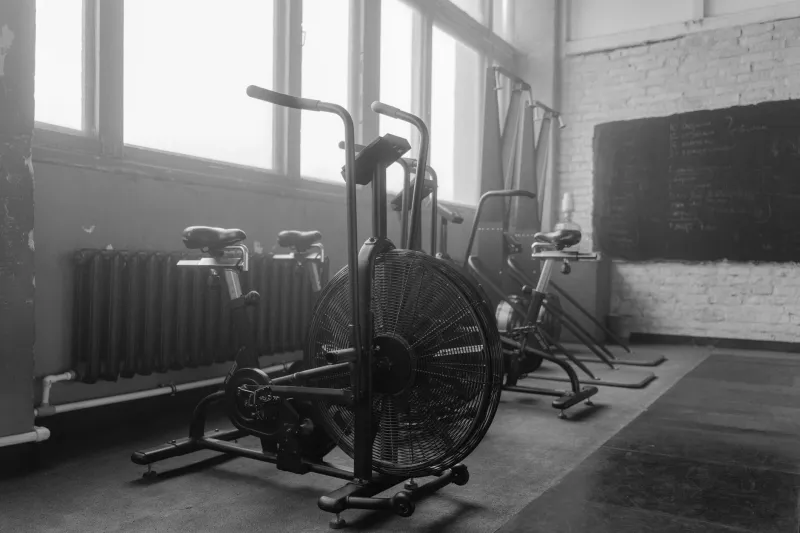
A commercial-grade stationary bike from a premium manufacturer retails somewhere between $3,000 and $8,000 new. A boutique studio running 50 bikes has, conservatively, a quarter-million dollars sitting in that one dimly lit room alone. Add the sound system (another $40K), the custom lighting rig (don't ask), the reception desk that looks like it was imported from a Scandinavian hotel lobby ($12,000, apparently), and the industrial HVAC required to make 30 people cycling furiously feel like a "luxury experience" — and you're looking at a single location with $400,000 to $600,000 in physical assets.
When that location closes — and increasingly, they are closing — all of that has to go somewhere. And that somewhere, my thrift-minded friends, is a liquidation auction that the general public almost never hears about.
Dave Kowalski, a 44-year-old HVAC contractor from outside Columbus, Ohio, has heard about them. Dave has made it something of a hobby — he prefers the term "strategic asset acquisition," but his wife calls it "buying more junk" — to monitor commercial liquidation platforms, county auction postings, and the occasional frantic Facebook Marketplace dump from a studio manager who just needs everything gone by Friday.
"I furnished my entire home gym for under $4,800," Dave told us, with the calm energy of a man who has genuinely won at something. "Treadmill that retailed for $9,000. Two commercial rowing machines. A cable weight system that I am fairly certain belonged to a gym that was charging people $200 a month to use it. I paid $400 for that cable system. Four hundred dollars."
He said "four hundred dollars" the way a person says grace before a particularly good meal.
How to Spot a Gym on the Way Down (Before It Hits the Ground)
Here's the thing nobody tells you about boutique fitness liquidations: the best deals don't come from the closure announcement. They come from the six weeks before the closure announcement, when the writing is already on the wall but the Yelp page still says "Open" and the Instagram is still posting motivational quotes about hustle.
Some field-tested warning signs to watch for:
The Class Schedule Gets Suspiciously Thin. A studio that used to offer 30 classes a week is now listing 11, and three of those are at 6 a.m. on a Wednesday. That's not a scheduling optimization. That's a business quietly removing overhead.
The Instructors Start Going Freelance. Fitness instructors talk. When the charismatic spin teacher who built a cult following suddenly announces they're "going independent" and "taking clients privately," they know something. Follow the instructor, find the collapse.
The App Gets Glitchy. Modern boutique gyms live and die by their booking apps. When the app stops updating, stops processing correctly, or quietly removes the "purchase membership" button — the lights are flickering.
The Merchandise Wall Gets Desperate. A healthy studio sells branded water bottles as a flex. A dying studio marks them down 60% and starts a "studio anniversary sale" in what is definitely not the anniversary month.
The Liquidation Pipeline: Where the Good Stuff Actually Goes
Contrary to what you might assume, the best boutique gym equipment rarely ends up at a Goodwill. The pipeline is more layered — and more navigable — than that.
First, the studio's lenders or landlords often hire a commercial liquidator. Companies like Heritage Global, Tiger Group, or any number of regional auction houses specialize in exactly this kind of asset disposal. Their auctions are online, public, and frequently feature equipment that still has the manufacturer's warranty sticker intact. Start there.
Second, and this is underappreciated: the landlord sometimes just wants it out. If a studio vacates a space and leaves equipment behind — which happens more than you'd think when a company dissolves quickly — the building owner becomes the de facto owner of whatever's left. A polite, direct call to a commercial property manager has produced some genuinely remarkable results for people who were simply willing to ask.
Third, watch your local Facebook Marketplace and OfferUp with the same intensity you'd bring to a fantasy football draft. Studio managers tasked with clearing a space on a deadline will post commercial equipment at prices that suggest they have personally given up on the concept of fair market value. This is not their fault. This is opportunity.
The Uncomfortable Truth About Gold's Gym
Here is something the boutique fitness industry will never admit publicly: Gold's Gym — unglamorous, slightly sticky, aggressively fluorescent Gold's Gym — has been quietly absorbing the equipment overflow from collapsed premium studios for years. Several franchise locations have essentially upgraded their entire cardio floors with commercial machines purchased at liquidation for a fraction of retail.
Which means the gym your bougie coworker refuses to join because it "doesn't have the right energy" may, in fact, contain the exact same bike they were paying $40 a class to ride two years ago. It just doesn't have the mood lighting and the DJ.
Life is funny like that.
A Final Word on Timing
The boutique fitness industry is not done collapsing. The economics remain brutal, the post-pandemic membership recovery has been uneven, and a new generation of AI-powered home fitness startups is already promising to disrupt the disruption. The cycle will repeat. The equipment will hit the market. The deals will materialize.
Your job — should you choose to accept it — is simply to be paying attention when they do. Set your alerts. Bookmark your liquidation platforms. And maybe, just maybe, invest in a good furniture dolly.
Your back will thank you. Your wallet will throw a parade.